

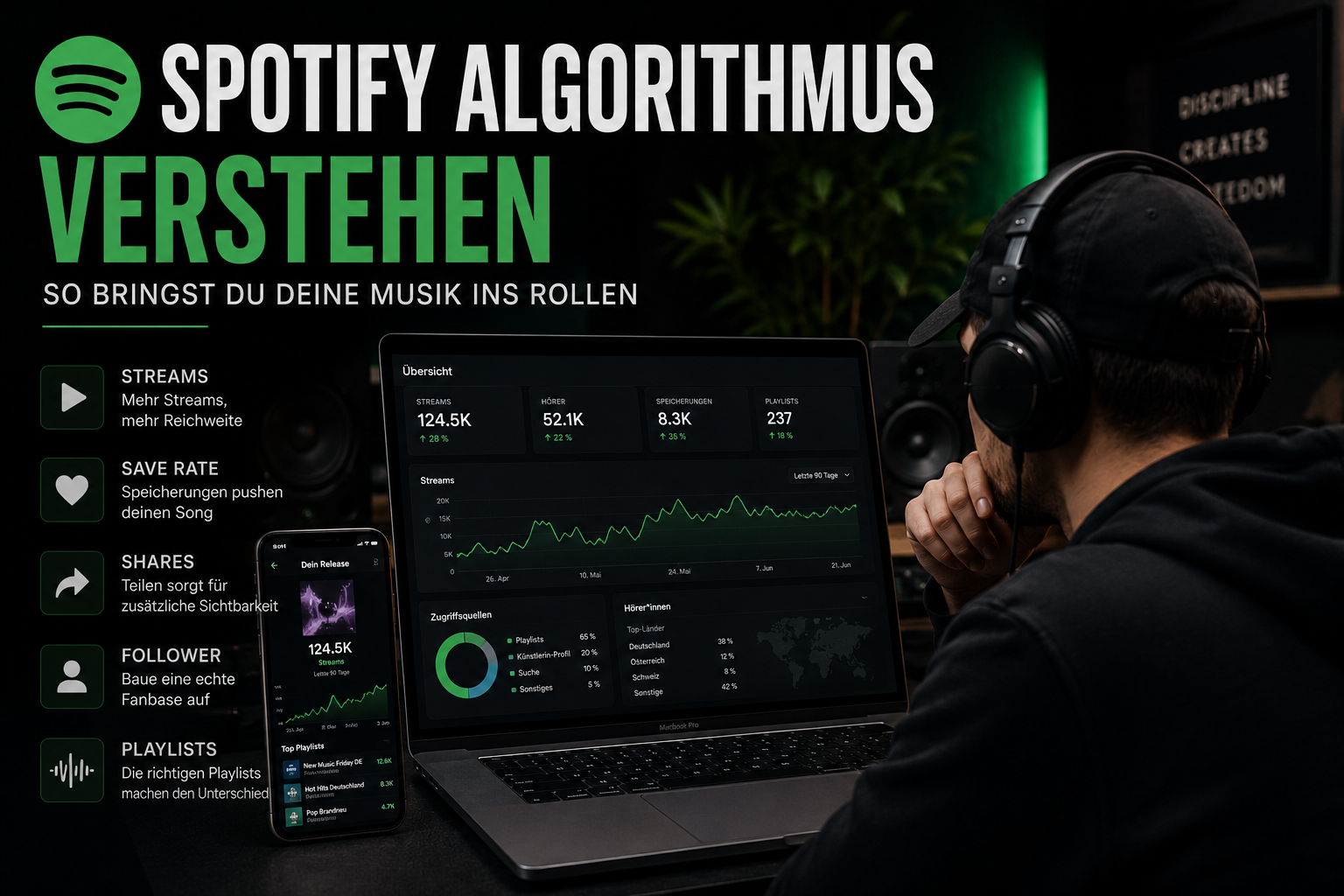
Spotify is remarkably good at matching its users' music taste and suggesting exactly the artists they'll love. But the real question for you as a musician is: How do you get your music recognized by this system in the first place and presented to the right listeners?
At OneCrewRecords, we get asked this question all the time – and the answer begins with understanding how Spotify actually "thinks". Here's everything you need to know about the algorithm, and how to make it work for you.
What's the technology behind the algorithm?
Spotify's recommendation system is called BART, short for "Bandits for Recommendations as Treatments". BART's job is simple to describe: keep listeners listening for as long as possible.
To do this, the system mixes familiar favorite songs with new tracks that fit the listener's previous taste but haven't been heard yet. That keeps the listening experience exciting without becoming too predictable.
Three main factors determine what gets served:
Natural language processing – The algorithm analyzes a track's lyrics, language, and thematic content.
Audio analysis – The raw audio signal is analyzed to detect the mood: driving, relaxed, dark, minimalist, instrumental, and so on.
Collaborative filtering – New songs are compared against previous listening behavior to decide whether they fit an individual's taste.
As soon as your music is live on Spotify via OneCrewRecords, you can put this mechanism to work for you – for example, through algorithmic playlists like Discover Weekly or Release Radar.
It's all about statistics
Like every big platform, Spotify is built on data. Hundreds of millions of users are continuously observed so that they can be shown more of what they like.
Some of the most important metrics for the algorithm include:
- Listening history (mood, style, genre)
- Skip rate – the fewer skips, the more recommendations
- Listening time – getting past the 30-second mark is especially important
- Playlist additions, whether personal, editorial, or curated by other users
The 30-second rule: myth or fact?
The first 30 seconds of a track are considered especially important – not least because a stream is monetized from that point on. If someone gets past this mark, the algorithm treats it as a positive signal.
That doesn't mean you should cut your next release into 30-second snippets. Whether to subordinate creative decisions to the algorithm is a personal call. One thing is certain: a strong intro that grabs listeners right away lowers your skip rate – and that pays off regardless of the algorithm.
Spotify CEO Daniel Ek has, by the way, commented on this topic himself and dismissed rumors that the system can be deliberately gamed with artificially short songs.
Timing matters too
The first 12 to 24 hours after release are critical. Listener numbers, skip rate, and listening time right after the release carry particularly heavy weight in the evaluation.
That means: build anticipation in advance, so that as many fans as possible listen to and save your track on day one. It's also worth checking the release calendar – if a very big artist from your genre releases on the same day, it can reduce your visibility.
Fridays are still considered the best release day, because they increase your chance of being added to the influential New Music Friday playlists.
Making targeted use of Discover Weekly & Release Radar
Making it onto Release Radar or Discover Weekly can significantly boost your stream numbers – these algorithmic playlists bring in more reach on average than other playlist formats.
Release Radar is simply based on your followers: as soon as someone follows your profile, new music from you automatically shows up there.
Discover Weekly is more complex. The playlist is based on listening behavior and on similarities to other users' playlists. Spotify itself describes the principle roughly like this: the system looks at what you've listened to and at which songs often appear in the same context but are still unknown to you. If a song regularly appears between tracks you already like, it ends up in your Discover Weekly.
One practical lever: ask friends, family, and your fanbase to put your track at the very top of their personal playlists. Every single playlist is factored into the calculation.
Setting tags correctly and pitching for playlists
If you're not using Spotify for Artists yet, now is the right time. Through the platform, you can submit your songs directly for playlists and add mood and genre tags.
These tags help decide who your song is suggested to. If they're set inaccurately, your track ends up with the wrong audience – and gets skipped more often as a result, which in turn hurts your skip rate.
Spotify is social media in disguise
Even if it doesn't look like it: at its core, Spotify works like a social network. The platform connects artists with fans and uses huge amounts of data to give listeners exactly what they want.
Spotify is just one building block in your overall social media ecosystem. Consistently link your other channels to your Spotify profile – the algorithm rewards it when new listeners find their way to you from outside the platform.
Your profile is more than just a business card
How long users stay on your profile, whether they follow your links or follow you, are valuable data points for Spotify. So use every option to fill out your profile completely: images, social links, bio, upcoming concerts, merch, and the verification of your profile. An incomplete profile wastes potential.
Using pre-saves as a head start
Since the first 24 hours after release decide so much, it's worth collecting pre-saves in advance. That way, you make sure a listener peak happens right on release day – exactly the signal the algorithm loves.
Conclusion
The Spotify algorithm captures pretty much everything: streaming peaks, fan engagement, playlist additions, and the behavior of hundreds of millions of listeners. If you want to be successful, you need a well-thought-out release strategy: build hype before the release, create real momentum, and make targeted use of the levers mentioned above.
Playlist additions and organic recommendations are often the decisive boost a career needs. With OneCrewRecords, you don't just have distribution at your side, but also the right tools to plan your release optimally.
Do you have questions about promoting your music on Spotify, or your own experiences with the algorithm? Feel free to write to us!
Kommentare
No comments yet. Be the first!