
The song is uploaded, the date is set, the announcement is out. Then release Friday comes, you celebrate for a moment, and before you know it you're back in the studio working on the next track.
That's how it goes for most people. And that's exactly where a lot of potential gets left on the table. Not because the music is bad, but because a few inconspicuous tasks around the release fall by the wayside. At OneCrewRecords, we see this again and again. Here are the five classics and what you can do about them.
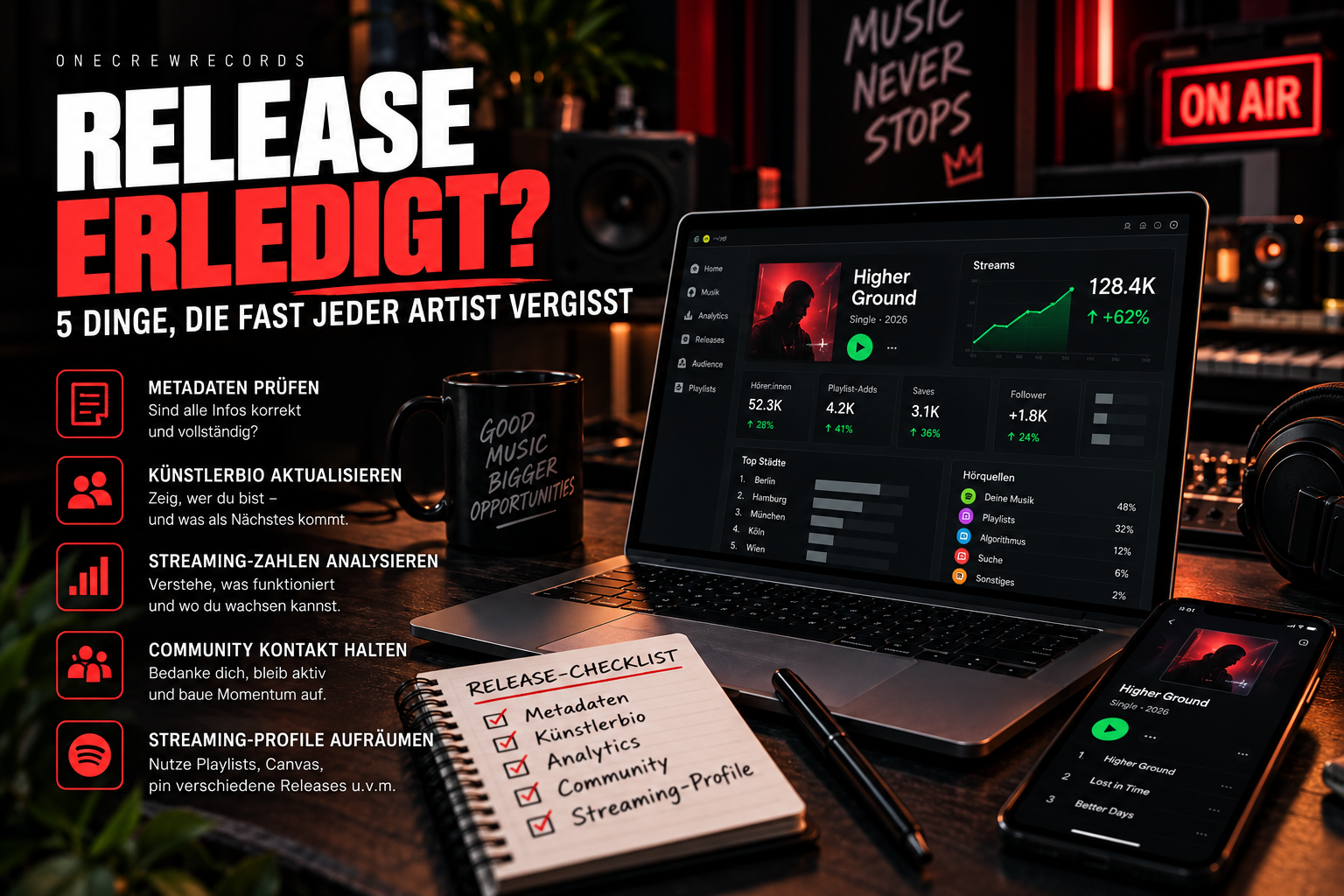
1. Metadata: unspectacular, but crucial
Metadata is the part nobody feels like dealing with. Still, it's worth a look, because mistakes are hard to fix after release. A wrong genre, missing songwriter credits, or a misspelled name for your featured guest are typical pitfalls.
This also affects visibility. Playlist curators often filter submitted songs by genre. If you file your track under the wrong one, it won't even show up in the right selection.
So set aside about 20 minutes before you submit and check everything carefully:
- Are all contributors (composition, lyrics, production) listed completely and spelled correctly?
- Does the genre really match what you hear?
- Is the title clean, meaning no emojis, duplicate "feat." credits, or wildly repeated punctuation?
- Does the cover have the required size and is it square?
At OneCrewRecords, the release checklist takes some of this work off your hands: it points out typical mistakes before you submit, before they become a problem.
2. An artist bio that makes people curious
When was the last time you touched your bio? On Spotify, Apple Music, in your press kit, or on your website?
The bio is one of the first things interested people look at. Journalists, radio editors, and playlist curators want to quickly understand who you are and what you stand for. An outdated or missing bio makes it look like you're not currently active, even if you release music regularly.
Here's how to get it right:
- Keep it short. A few sentences are enough.
- Stay up to date. New releases and achievements belong in it.
- Write in the third person. That way it can be used as is.
- Start with something concrete. Begin with something tangible, not a list of buzzwords.
An example of the difference: "Rapper from Leipzig" says little. "Max tells stories over raw boom-bap beats about commuting between night shifts and the studio," on the other hand, sticks with you.
3. Look at the numbers while the release is fresh
In the first two to four weeks after a release, you get the most data on a song. Spotify for Artists, Apple Music for Artists, and your distributor's dashboard show you where your listeners come from, how they found the track, and which playlists it ended up in.
Very few people take a look. But you don't have to be a data pro. Even small insights can change your planning: maybe a large share of your listeners come from a city you never had on your radar. Or a playlist you've never heard of is responsible for the most saves.
Take half an hour, write down three things you learned, and put them into practice with your next release.
4. Stay in touch with your community
The first 48 hours after release are particularly revealing for the platforms. Comments, shares, saves, and playlist adds show whether a song resonates with people, and that partly determines whether it gets recommended to more listeners.
So your behavior during this time really does matter:
- Reply to comments, and do it properly. A heart emoji isn't enough. Ask which line stuck with them the most.
- Share posts that mention your song.
- Stay approachable, even when everyday life calls.
Altogether, this takes maybe five minutes a day, but it creates a real connection.
Tip: Short video replies are working especially well right now. If you're active on TikTok or Instagram Reels, record 10 to 20 seconds and speak directly into the camera. It doesn't have to be staged. Replying authentically has more impact than any show.
The community on OneCrewRecords also thrives on interaction. In the forum and in the charts, you can connect with other musicians and music fans and gather feedback on your release.
5. Tidy up your streaming profiles
This usually takes less than an hour, and yet a surprising number of people have never done it properly.
- Spotify: In the artist pick, set your latest release as a highlight. Check that your profile picture is up to date and also looks good on a smartphone. Most people listen there. And check whether your discography is laid out logically for someone discovering you for the first time.
- Apple Music: Make sure you have a high-resolution artist image and that your highlights are set correctly.
- Other platforms: Amazon Music for Artists and Deezer also offer their own artist access. It's worth setting up, even if you rarely stop by there. The more complete your presence looks everywhere, the more professional you come across.
The verification assistant in the dashboard will walk you through, step by step, how to get access on each platform.
Conclusion: No magic, just discipline
None of this is complicated. You don't need a big budget or a team. The only difficult part is sticking with it while you're also writing, recording, promoting, and organizing the rest of your life.
That's why a fixed routine helps: create a small checklist and work through it with every release. After two or three runs, it almost runs itself.
Want someone to take care of distribution so your head is free for the music? Then check out OneCrewRecords. We help you get your releases onto the platforms properly and with all the trimmings.
What about you? What do you do before a release, and what have you forgotten before? Share your best tips with us in the comments.
Comments
No comments yet. Be the first!