

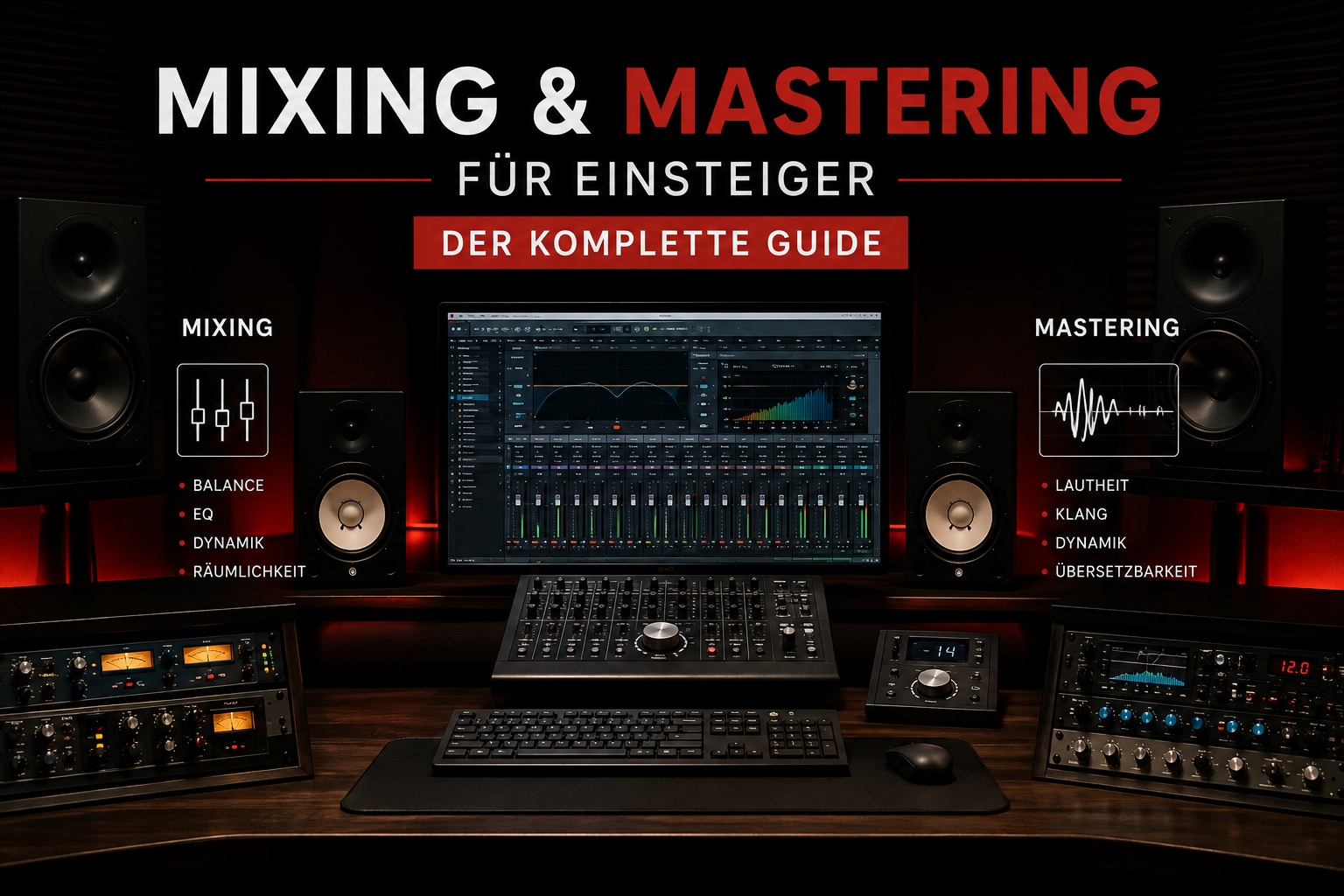
If you're diving into the world of music production for the first time, you'll quickly run into a jumble of technical terms, half-knowledge, and advice that contradicts itself when it comes to mixing and mastering. That's no coincidence – mixing and mastering are genuinely among the most demanding disciplines in music production, and every experienced engineer has their own opinion on them.
The good news: you can start today anyway. Just like you learn to paint by simply starting to paint, you learn mixing and mastering by working on your own tracks – even if your first attempts won't sound like radio.
Do I mix it myself or hand it off?
Before you get started, it's worth taking an honest look at where you stand. Are you primarily a musician and see production as more of a necessary evil? Then it can make sense to pay for professional mixing or mastering, or to use an automated mastering service. Do you, on the other hand, really want to understand how sound comes about, and are you ready to invest time? Then taking control yourself is worth it.
Important here: your expectations and your patience need to match. If you expect radio quality from your very first mix, you'll be disappointed. And no mastering plugin in the world can rescue a mix at the push of a button. Continuous improvement – not perfection on the first try – is the real goal.
The basic equipment to get started
If you already record at home, you probably already have everything you need to get started. If you're starting from zero, you essentially only need three things:
- A computer with DAW software (Digital Audio Workstation)
- An audio interface with solid stereo quality
- A pair of reference monitors of reasonable quality
You don't have to use up your entire budget for this. Building experience as an audio engineer takes time – and working with entry-level gear in particular sharpens your ears and your eye for detail. Yes, at some point you'll hit the limits of your equipment. But that's exactly what helps you truly understand the production process.
The sound of your room has a say, too
Good studio monitors are available today for under 500 euros and deliver a quality that would have cost many times more 50 years ago. But the monitors are only half the battle.
A speaker converts electrical energy into movement, which in turn sets air molecules vibrating. From that point on, the room takes over: walls, ceiling, and floor influence what you actually end up hearing. If even highly rated monitors sound strange in your room, the problem usually isn't the speaker but the room.
Room acoustics are the biggest technical hurdle in a home studio. Acoustic treatment is worth tackling roughly in this order:
- Monitor decoupling – monitor stands and/or isolation pads
- Reflection control – acoustic foam at the points where sound reflects off the walls behind and beside the monitors
- Bass traps – thick foam wedges in room corners, where low frequencies build up
Take it step by step. Even simple monitor pads bring a noticeable improvement, and reflection control adds another boost. This isn't about soundproofing in the classic sense, but about how sound moves through your room. Professional mastering studios invest six-figure sums in exactly this problem – every small step you take yourself brings audible progress.
Train your ears
Even while you're working on your room acoustics, you can keep developing – namely by calibrating your ears. Good productions sound good on any system. Before you mix or master yourself, it's worth doing a reference comparison.
Take a commercial production from a genre similar to your own project and listen to it through your own setup. Pay close attention to the most important instruments, how the mix works together, and the sound of the vocals.
Your ears and brain are the most adaptable audio tool you will ever own. It's tempting to read up on other engineers' latest equipment – but in the end, all that matters is how your track actually sounds.
Beware of the preset curse
Notable about the basic equipment above: no plugins. There's a reason for that – you probably don't need them to get started. Most DAWs already come with solid built-in tools. Additional plugins can still enrich your work once you've understood the basics.
The problem lies elsewhere: in the "preset curse." You find a preset with a fitting name, click it, everything sounds louder and brighter – done and dusted. The catch: loudness does grab attention, but it often comes at the expense of dynamics and musical depth. For certain genres like EDM, a loud, compressed sound may be desired – for most music, it isn't.
Every time you adopt a preset without adapting it to your song, you make a compromise and miss a chance to learn. Take the time to truly understand compressor, EQ, and limiter, and set them individually for each track. Every song is different – your ear should treat it that way.
Your own path
There are countless step-by-step guides to mixing and mastering online. The problem: they almost always reflect only one person's perspective, whether it's about a specific genre or a specific DAW version.
With the sheer number of possible combinations of equipment, software, and music style, no single article – not even this one – can provide all the answers. What counts is your own combination of tools, ears, and taste. That's exactly what, over time, gives rise to your personal sound.
This personal style often takes years to develop – consciously or unconsciously. In the end, what matters is what you want to achieve: Do you want to turn this into a career, or are you producing for yourself? Both are legitimate. Mixing and mastering are craft and creative expression at once – and that's exactly what makes them so rewarding to learn.
Conclusion: Mixing and mastering are complex disciplines, but with the right basic equipment, a treated room, and trained ears, you'll make progress as a beginner faster than you think. At OneCrewRecords, we care about artists being able to produce and release their music on their own terms – so always keep 100 % of your rights and find your own sound.



Kommentare
No comments yet. Be the first!