

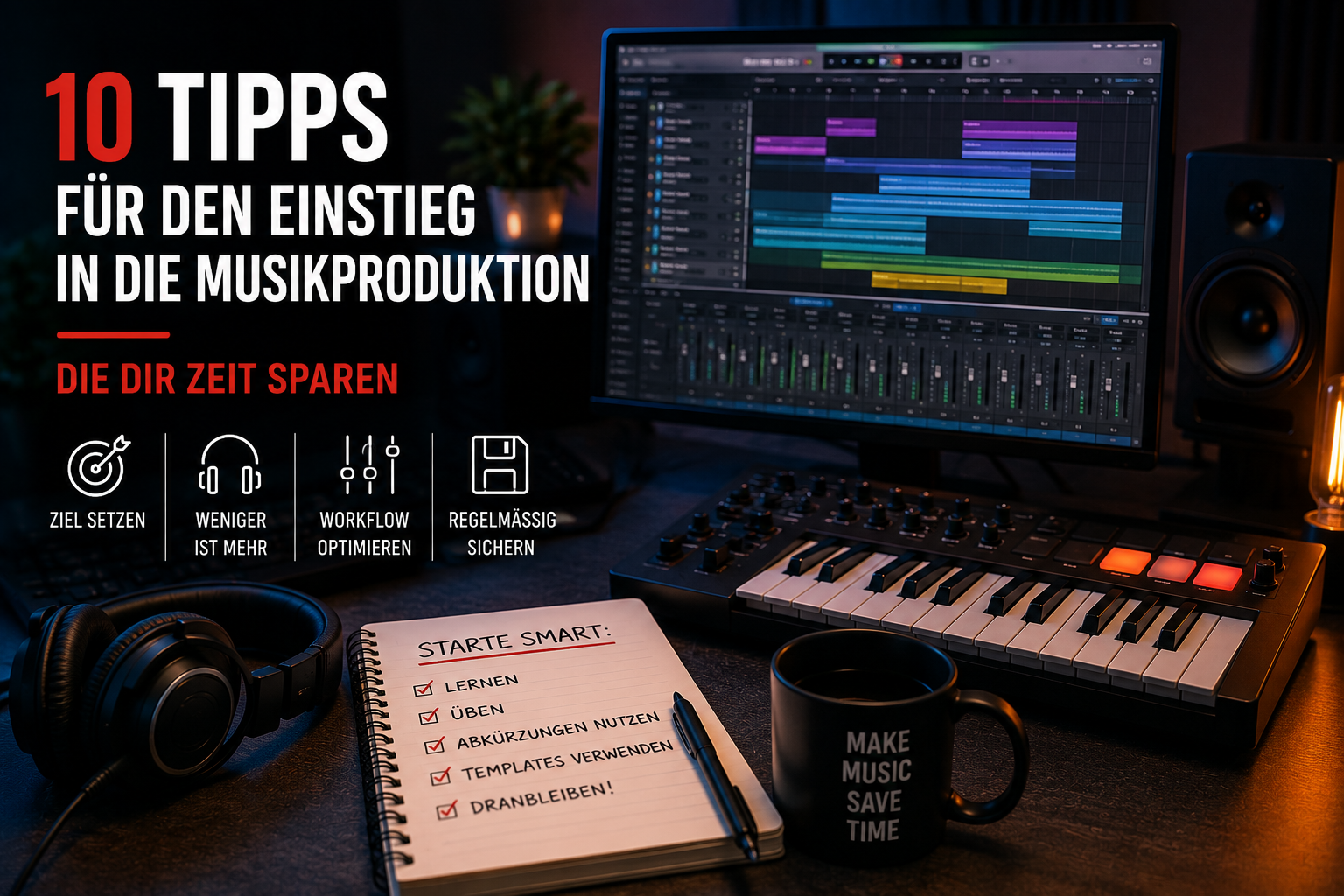
Everyone who builds beats, mixes tracks or produces entire songs today started from zero at some point. The good news: you don't have to take the same detours as everyone before you. At OneCrewRecords, we keep seeing the same beginner mistakes among our artists – and just as often the same questions about equipment, workflow and mindset. That's why we've put together ten points here that will really help you at the start, whether you want to become more of a beatmaker, an all-round producer or a mix engineer.
1. Buy brains first, then hardware
The most expensive signal chain doesn't automatically make you a better producer. At the beginning, what matters most is that you can work cleanly at all. A decent computer with enough processing power, sufficient RAM and a fast hard drive is the foundation – two monitors make your workflow noticeably more comfortable, if your budget allows it.
A simple audio interface with two inputs and outputs and a compact 25-key MIDI keyboard are completely enough. A solid pair of headphones and a pair of studio monitors round off your setup – switch between the two deliberately, because that exact comparison trains your ear the fastest. If you record vocals, an affordable large-diaphragm microphone is completely enough at first to get usable results. You can get more expensive gear once you know exactly where your journey is heading.
2. Don't underestimate your room
One point many beginners completely ignore: the acoustics of the room they work in. Even with high-end equipment, your mixes will sound off if the room itself distorts the signal. The good news: a usable basic treatment doesn't cost the earth.
Three things matter most: reducing reverb, getting bass buildup in the corners under control and catching the ceiling reflection with a cloud panel. For the back wall, diffusers are worthwhile, as they scatter the sound instead of absorbing it. Go for real absorbers made of stone wool or glass fiber wool instead of cheap acoustic foam – and don't overdo it. A room that sounds completely dead is just as problematic as one that's too echoey. Room acoustics have an enormous influence on how your finished sound really turns out – it's worth taking seriously.
3. Find your DAW and stick with it
Producing digitally means you can go back at any time and correct things without losing analog material like in the old days. Your DAW (Digital Audio Workstation) is the tool you use to compose, record, mix and master – all in one place.
There is no "right" DAW. Some are better suited to beatmaking, others to classic band productions, and others still to mixing workflows. Try out free versions and trials until one fits you – and then stick with it. In the end, it's not the software that determines the quality of your music, but how well you master it.
4. Trust your ears first, then your eyes
A spectrum analyzer, loudness meter or VU meters are helpful tools – no question. The problem: many beginners rely too much on what they see on the screen instead of what they actually hear.
Music is first and foremost an acoustic experience. Visual aids can support you, but should never make your decisions on their own. A simple but effective trick: every now and then, deliberately close your eyes while listening to your track. Without visual distraction, your hearing sharpens, and you make more accurate decisions.
5. Analyze reference tracks from your genre
If you want to produce in a particular genre, you should know exactly how professional releases in that style sound. Deliberately take the time to listen to a few of your favorite songs – not to enjoy them, but to analyze them.
Pay attention to typical elements of the genre, the usual BPM range, the interplay of the individual instruments and how the elements are weighted in the mix. Write down what you hear. This exercise gets you further, faster, than hours of trial and error, because you're training your ear specifically on the standards of your genre.
6. Let yourself be inspired, but don't copy
Reference tracks are valuable, but they hold a trap: it's tempting to adopt elements almost one to one. That's exactly what you should avoid. Use your analyses as orientation and a starting point, not as a blueprint.
Instead, bring in your own feeling and your own ideas. It's precisely the mix of genre standards and a personal signature that ultimately makes a recognizable sound – and that's ultimately what makes labels, playlist curators and listeners stick with an artist.
7. Less is almost always more
The impulse to fill every gap in the track with another element is present in almost every beginner. That's usually the wrong way to go. "Less is more" applies practically everywhere in music production:
- Production: Not every empty spot in the arrangement needs an additional element.
- Layering: Several kicks or snares on top of each other rarely add anything, and often just create mud.
- Arrangement: Too many transitions and fills dilute the song instead of making it more exciting.
- Recording: You don't need twenty takes of the same line – two to three good versions almost always do the job.
- Mixing & Mastering: If a track needs ten plugins to sound usable, the problem usually already lies in the production.
A track that is deliberately reduced but sounds clear almost always works better than one that's overloaded with elements.
8. Watch others at work
An internship at a studio or sessions with experienced producers are worth their weight in gold – if you have the opportunity, use it. If not, there are plenty of other sources: YouTube tutorials, online courses, specialist literature or a close study of mixdowns you like.
However, you learn the most when you watch someone produce or mix live and can ask questions right away. Why does the person make exactly this decision? Why at this spot in the track? Asking questions like this often gets you further, faster, than weeks on your own.
9. Get honest feedback
Music is rarely created in complete isolation. Play your tracks for other people – friends, other producers, experienced ears – and actively ask for their opinion. From untrained listeners, you get a good sense of how your track comes across to a broader audience. From experienced producers or engineers, you often get concrete, actionable criticism.
Important: don't take feedback literally as law. Weigh which advice really fits your vision, and filter out the rest. Not every opinion is helpful – but the right ones will noticeably move you forward.
10. Breaks are part of the job, not a waste of time
Mixing for seven or eight hours straight without a break is not a good idea – even if you don't notice it in the moment. Your ears tire faster than you think, and with tired ears you make worse decisions that you'll have to correct again the next day. Likewise, you shouldn't go straight into sensitive mixing decisions after a loud night.
Deliberately plan short breaks – about ten minutes per hour – and avoid sessions that last longer than three hours at a stretch. If you have to work longer, take a longer break afterwards. Rested ears are, in the end, one of the most underrated success factors in music production.
These are the ten points that keep coming up in conversations with our artists at OneCrewRecords – and that really make a difference at the start. There's surely more that could be added, but anyone who takes these ten to heart has already skipped a big part of the typical beginner mistakes. Feel free to write to us and tell us which tips helped you the most or what's missing from your experience.

Kommentare
No comments yet. Be the first!